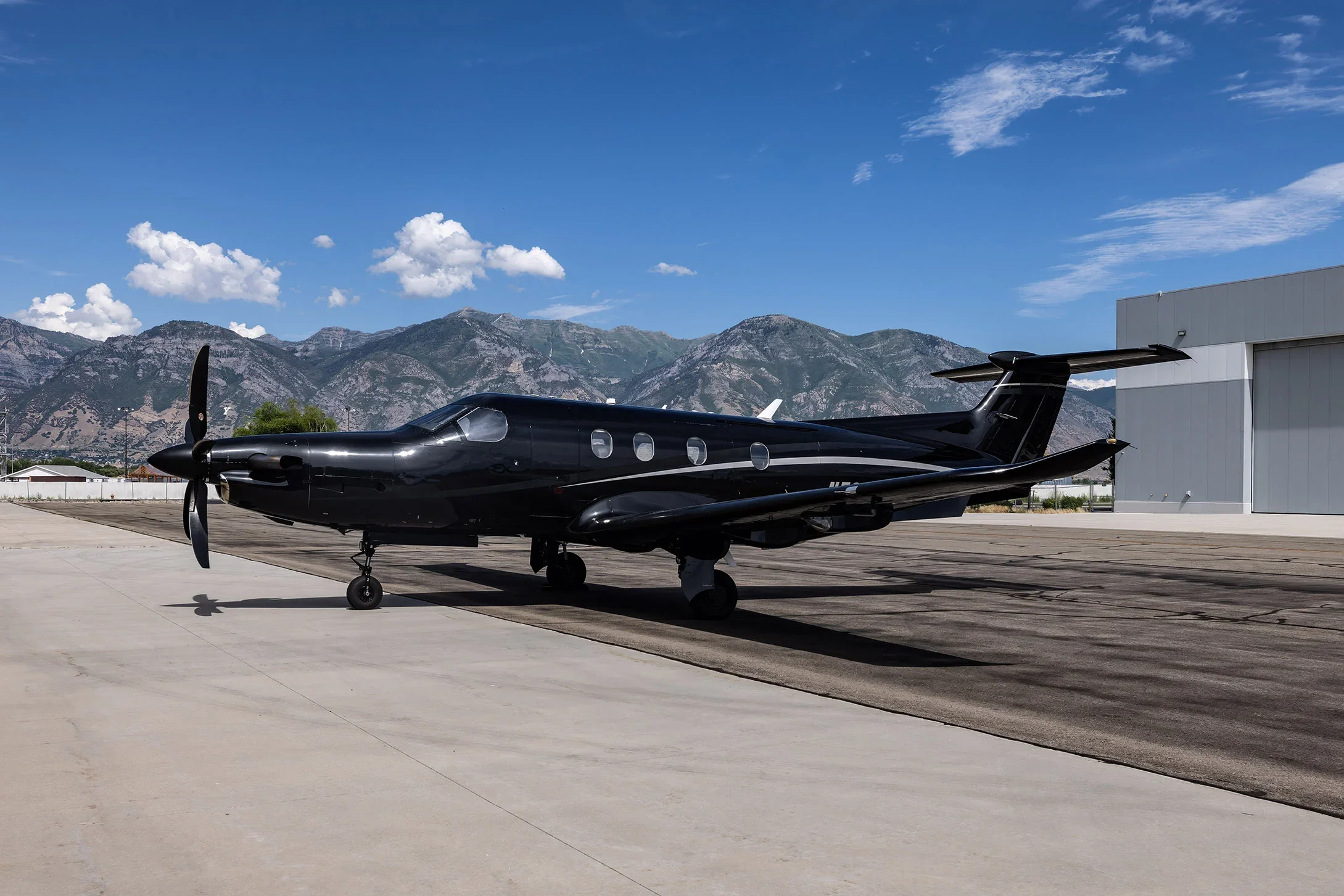
Turboprop Charter
The Swiss-army knife of private aviation — range, comfort, and versatility.
Why Charter This Aircraft
Pratt & Whitney PT6A-67P turboprop.
Impressive range depending on variant.
Operates on short and unpaved runways.
Executive configuration for comfort.
Over 2,000 aircraft delivered since inception.
Development & Background
In the late 1980s, Pilatus Aircraft set out to create a single-engine, pressurized aircraft that could serve both cargo and passenger needs while operating from almost any airstrip.
The first flight took place in 1991, and after three years of testing, the aircraft was certified — quickly becoming a global success. Operators noticed a rugged design, long range, and economical performance, making it ideal for civilian, medevac, cargo, and government use.
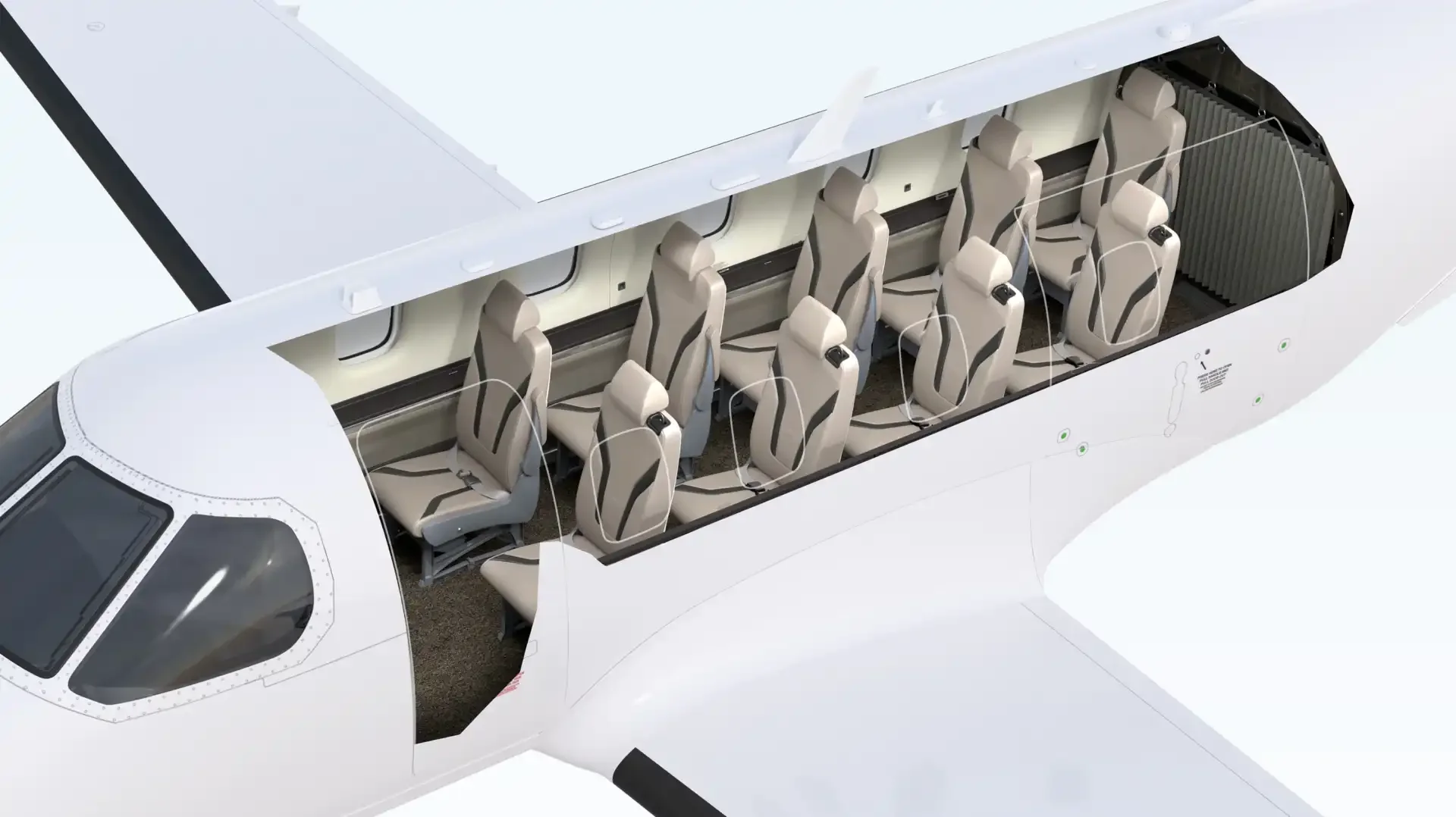
The PC-12 was equipped with the Pratt & Whitney PT6A-67A, an engine known for dependability and power efficiency. The airframe was built from robust aluminum for high-cycle usage and rough-field performance, while a flat-floor cabin, fully enclosed lavatory, pressurization system, and club seating for up to eight passengers rounded out a genuinely spacious interior.
In 2006, the PC-12 NG (Next Generation) arrived with an improved engine (PT6A-67P), enhanced Honeywell Primus Apex avionics, and improved performance. After 14 years largely unchanged, Pilatus revamped the model again with the PC-12 NGX — a newer engine (PT6E-67XP), autothrottle, upgraded avionics, and a more efficient propeller for greater cruise speed and range.
In 2025, Pilatus released the PC-12 PRO, focused on luxury VIP interiors and high-end configurations alongside new safety features: autothrottle, an emergency autoland system, Smart Glide, Electronic Stability Protection, a larger weather radar, and an updated cockpit with the new Garmin G3000 Prime avionics suite for sharper risk management and situational awareness.
"The PC-12 gives the feel of a small jet but the flexibility of a bush plane — truly remarkable."
"It's efficient, reliable, and can get into airports jets can't. The best utility aircraft in business aviation."
Specifications
| Metric | PC-12 NG | PC-12 NGX | PC-12 PRO |
|---|---|---|---|
| Engine | Pratt & Whitney PT6A-67P | PT6E-67XP | PT6E-67XP |
| Max Cruise Speed | 270 KTAS | 285 KTAS | 285 KTAS |
| Long Range Cruise Speed | 250 KTAS | 265 KTAS | 265 KTAS |
| Max Range (4 pax + reserves) | 1,560 nm | 1,845 nm | 1,845 nm |
| Service Ceiling | 30,000 ft | 30,000 ft | 30,000 ft |
| Takeoff Distance (MTOW, SL) | 2,650 ft | 2,485 ft | 2,485 ft |
| Landing Distance | 2,170 ft | 2,000 ft | 2,000 ft |
| Cabin Dimensions (L×W×H) | 16.9 ft × 5.0 ft × 4.9 ft | 16.9 ft × 5.0 ft × 4.9 ft | 16.9 ft × 5.0 ft × 4.9 ft |
| Passenger Capacity | 6–9 | 6–9 | 6–9 |
| Baggage Capacity | 150 cu ft | 150 cu ft | 150 cu ft |
| MTOW | 10,450 lbs | 10,450 lbs | 10,450 lbs |
Cabin & Interior Experience
Step inside and you'll immediately notice how easy it is to move through the flat-floor cabin. Standard executive seating accommodates 6 to 8 passengers, with a fully enclosed lavatory as standard.
An optional refreshment center up front and Wi-Fi — depending on the operator — round out the experience for longer missions.
Capabilities & Performance
The combination of fuselage, engine, and airframe gives the Pilatus PC-12 superb operating flexibility, letting it land in places most jets simply can't. A standard cruise speed of 285 KTAS (Mach 0.45) is paired with an operational ceiling of 30,000 ft.
Cruising between 20,000 and 27,000 ft, fuel burn runs just 65–70 gallons per hour, with a range of up to 1,800 nm under NBAA reserves — making city pairs like Houston–Aspen, Dallas–Chicago, or Miami–Turks & Caicos entirely possible.
Request a Quote
Tell us your route and dates — a dedicated advisor will respond with availability within one business hour.
Request a Quote